Key Takeaways
- Edge computing brings data processing closer to IoT devices.
- Real-time processing reduces latency and bandwidth usage.
- Local data handling enhances security.
- Improved reliability with reduced dependency on centralized cloud systems.
- A cost-effective solution for IoT deployments.
Introduction to Edge Computing in IoT
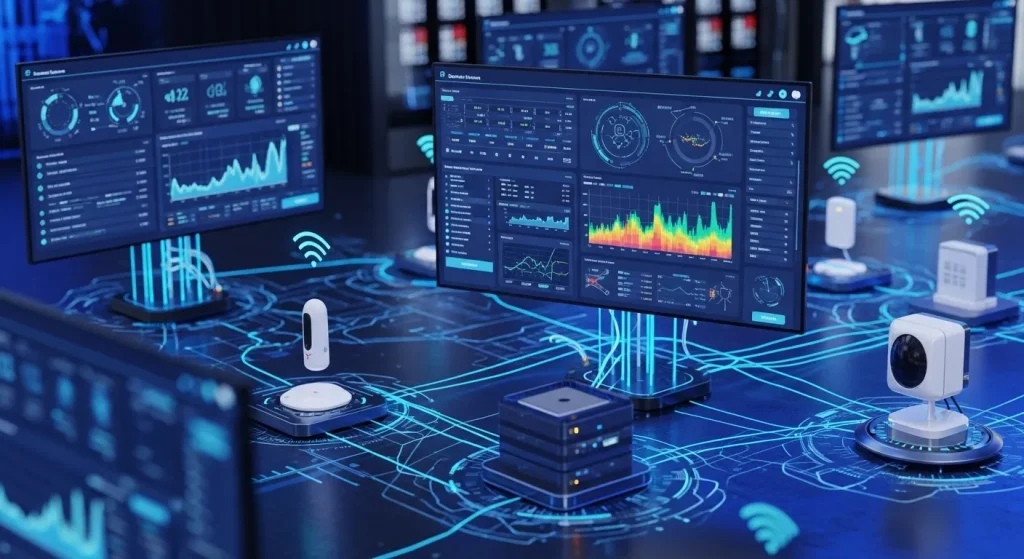
Edge computing is transforming the way Internet of Things (IoT) devices capture, process, and use data. Unlike traditional cloud-based systems, where raw data must travel long distances to centralized servers, edge computing shifts computation and storage closer to the data source. This allows organizations to achieve faster response times, lower bandwidth consumption, and enhanced reliability. In industries such as healthcare, smart cities, logistics, and manufacturing, this shift is revolutionizing operational efficiency and enabling real-time decision-making.
The Evolution of IoT Data Processing
Traditional Cloud Computing
For years, cloud computing dominated IoT architectures. Data collected by sensors, cameras, and connected devices was transmitted directly to the cloud for analysis. While effective for large-scale data storage, this approach had limitations:
- All data sent to remote servers increases latency.
- Bandwidth costs scale with network traffic.
- Centralized data creates a single point of failure.
- Limited functionality in environments with poor or no connectivity.
Edge Computing Approach
Edge computing reverses this model by enabling processing locally at the “edge”—within gateways, on edge servers, or directly on devices. This shift offers major benefits:
- Local data processing reduces latency for mission-critical applications.
- Bandwidth usage decreases as only relevant data is sent to the cloud.
- Offline functionality ensures operations continue even during outages.
- Reliability improves by eliminating total cloud dependency.
Key Components of Edge-IoT Systems
1. Edge Devices
Central to any edge ecosystem are the devices themselves. This category includes:
- IoT sensors and actuators generating or acting upon data.
- Edge gateways serving as bridges between local devices and cloud systems.
- Local processing units such as microcontrollers or embedded processors.
- Storage systems for temporary or long-term data retention.
- Network interfaces enabling secure, efficient communication.
2. Edge Software Stack
Hardware alone is not sufficient. Powerful software integration ensures smooth operation, including:
- Edge operating systems optimized for lightweight performance.
- Container platforms for flexible application deployment.
- AI/ML frameworks allowing local predictions and anomaly detection.
- Security protocols enforcing trust between devices.
- Management tools for monitoring performance and scalability.
Implementation Strategies
Device Selection
Choosing the right devices depends on:
- Processing requirements: matching hardware with computing needs.
- Power constraints: optimizing energy usage in mobile or remote devices.
- Environmental conditions: ensuring ruggedness in harsh industrial or outdoor settings.
- Cost considerations: balancing capability with budget.
- Scalability needs: preparing for future expansion.
Network Architecture
An effective architecture ensures seamless communication across IoT ecosystems. Considerations include:
- Local network topology for efficient traffic flow.
- Cloud connectivity to synchronize data when required.
- Secure data synchronization across nodes.
- Failover mechanisms to guarantee service continuity.
Security Considerations
Data Protection
Edge computing strengthens security by keeping sensitive data closer to where it is generated. Best practices include:
- End-to-end encryption for data in motion and at rest.
- Role-based access control to limit unauthorized access.
- Secure boot mechanisms to protect system integrity.
- Routine updates to address vulnerabilities.
- Intelligent threat detection to identify malicious activity.
Network Security
The edge network must be safeguarded with:
- Firewalls controlling traffic in and out.
- VPN connections to protect remote communication.
- Intrusion detection systems to flag suspicious patterns.
- Real-time traffic monitoring.
- Organization-wide security policies to ensure compliance.
Performance Optimization
Resource Management
Maximizing performance at the edge involves:
- Load balancing across processing nodes.
- Cache management for quick data retrieval.
- Power optimization, especially for battery-powered devices.
- Storage and memory allocation for efficiency.
- Fine-tuned network optimization to avoid congestion.
Data Processing
Efficient data workflow is essential:
- Filtering raw data to eliminate redundancies.
- Compression methods to save bandwidth.
- Batch processing where real-time action is not required.
- Real-time analytics for critical insights.
- Data prioritization to ensure time-sensitive tasks take precedence.
Real-World Applications
Case Study: Smart Manufacturing
A manufacturing facility adopted edge computing to modernize its IoT-driven production systems, with impressive results:
- Latency reduced by 60%, enabling near-instant feedback loops.
- Bandwidth usage cut by 40% due to local analytics.
- Production efficiency streamlined, reducing downtime.
- Enhanced quality control with real-time defect detection.
- Predictive maintenance powered by on-site machine learning, extending equipment life.
Similar benefits are being realized in healthcare for patient monitoring, in retail for automated checkout, and in smart cities for traffic management.
Future Trends
The future of edge computing in IoT promises even greater transformation:
- AI at the edge will enable autonomous, context-aware decision-making.
- 5G networks will provide ultra-low latency and high-speed connectivity.
- Advanced security models will strengthen resilience against evolving cyber threats.
- Autonomous systems, from vehicles to drones, will thrive with edge-driven intelligence.
- Edge-native applications, built specifically for edge environments, will emerge.
FAQ
What are the main benefits of edge computing for IoT?
Edge computing reduces latency, saves bandwidth, enhances security, and improves reliability for IoT deployments.
How does edge computing improve IoT security?
By processing sensitive data locally, exposure to external threats is minimized, while encryption and access control further protect integrity.
What should organizations consider before adopting edge computing?
Key considerations include device capabilities, network infrastructure, security requirements, compliance, and scalability for long-term growth.
Conclusion
Edge computing is redefining IoT by moving intelligence closer to devices and end users. This distributed architecture improves speed, efficiency, and security, while reducing costs. For organizations seeking to future-proof IoT strategies, embracing edge computing is more than an option—it is becoming a necessity.
Next Steps
If you are ready to explore edge computing for your IoT deployments, begin by:
- Assessing current and future IoT requirements.
- Evaluating leading edge computing platforms.
- Designing a scalable implementation roadmap.
- Testing, deploying, and refining your system.
By adopting edge-first strategies, businesses can achieve real-time insights, drive innovation, and maintain a competitive edge in increasingly connected environments.